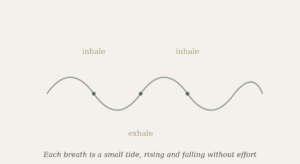
Watts frequently returned to the breath in his talks, pointing out that breathing is unique among bodily functions: it happens automatically, yet we can also consciously direct it. This makes the breath a natural bridge between the body’s involuntary world and the mind’s voluntary attention — a place where we can meet ourselves.
Zen practice has used breath awareness as a foundation for centuries, not as a technique to escape the body but as a way to inhabit it more fully. Modern physiology now explains part of why this works: slow, deliberate breathing activates the vagus nerve, which signals the parasympathetic nervous system to shift the body out of fight-or-flight and into rest-and-digest. Heart rate slows. Blood pressure eases. Muscles that did not even register as tense begin to loosen. The breath, in this sense, is not just a metaphor for presence — it is a direct physiological lever for calm, available in every moment, requiring no equipment, no appointment, and no permission.