
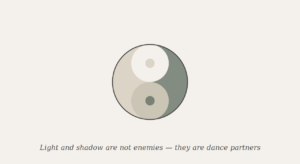
In one of his well-known lectures, Watts described how much suffering comes from what he called the “game of black and white” — the habit of dividing experience into strict opposites: good versus bad, success versus failure, win versus lose. This binary thinking can feel orderly, but it is also brittle, because life rarely holds still inside such clean categories.
Buddhism approaches this through the idea of the Middle Way — not a compromise between two extremes, but a recognition that opposites are often more interconnected than they appear, the way light is only visible in contrast to shadow. Holding paradox — being able to sit with two seemingly contradictory truths at once — is associated in psychological research with greater cognitive flexibility and resilience under stress. Rigid either-or thinking, by contrast, tends to amplify distress when reality refuses to fit neatly into one box. Learning to hold light and shadow together, rather than forcing a winner, is often where real peace of mind begins.