Modern life constantly pulls us away from the present moment. We worry about the future, replay the past, check our phones, compare ourselves to others, and rush through experiences as if life is something waiting for us later.
But the truth is simple: life only happens now.
Not tomorrow. Not yesterday. Not “when everything is finally perfect.” Life is this breath, this step, this conversation, this second.
The idea of living in the moment is not new. It appears in the teachings of Alan Watts, in Buddhism, and in Stoic philosophy. Although these traditions use different language, they point toward the same wisdom: peace, clarity, and fulfillment are found by being fully present with reality as it unfolds.
The Present Moment Is the Only Place Life Exists
Alan Watts often spoke about the illusion of time and the way humans trap themselves in mental stories. We live as if the future is the destination and the present is merely a tool to get there.
We say:
- “I’ll be happy when I get the job.”
- “I’ll relax once I have more money.”
- “I’ll enjoy life after I solve all my problems.”
- “I’ll feel complete when I become a better version of myself.”
But when the future arrives, it arrives as the present. Then the mind creates another future to chase.
Watts compared life to music or dancing. The purpose of a song is not to rush to the final note. The purpose of dancing is not to arrive at a particular spot on the floor. The joy is in the movement itself.
Life is the same. If we treat every moment as merely a stepping stone to the next, we miss the entire experience.
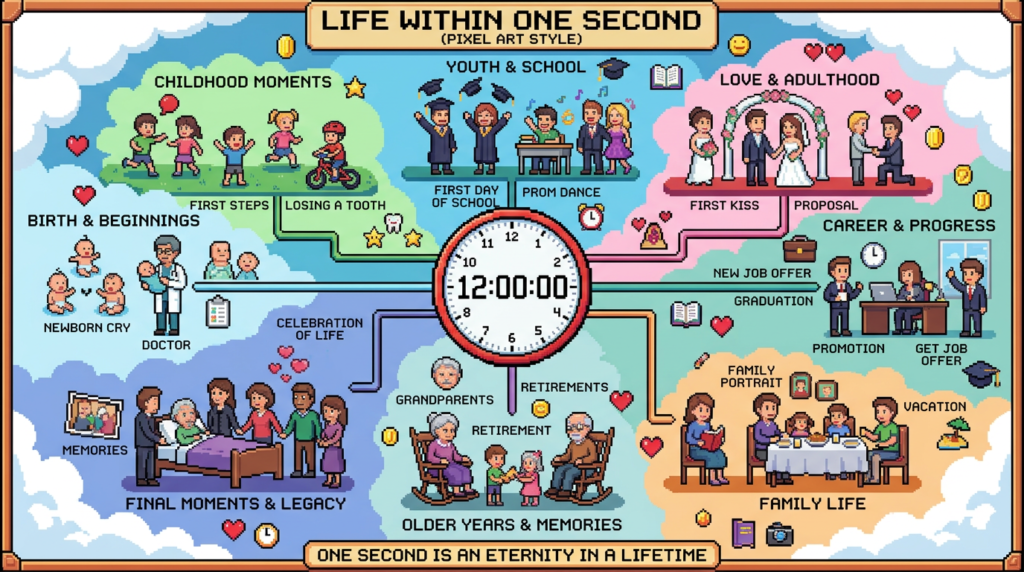
To live one second at a time is to stop treating life like a race and begin experiencing it like music.
Buddhism: Peace Begins With Awareness
Buddhism teaches that much of human suffering comes from attachment, craving, and resistance. We suffer when we demand that reality be different from what it is.
The mind says:
- “This should not be happening.”
- “I need this to last forever.”
- “I cannot be happy unless I get what I want.”
- “I am afraid of losing what I have.”
Buddhist practice invites us to observe these thoughts without becoming trapped by them. Through mindfulness, we learn to notice what is happening in the present moment: the breath, the body, the emotions, the sounds, the sensations, the thoughts passing through awareness.
This does not mean ignoring problems or pretending everything is perfect. It means meeting life clearly instead of being lost in fear, regret, or fantasy.
When you are present, you can respond instead of react.
You can feel anger without becoming anger.
You can notice anxiety without being controlled by it.
You can experience sadness without believing it will define you forever.
One breath at a time, you return to now.
Stoicism: Focus on What Is in Your Control
Stoicism, the ancient philosophy practiced by thinkers like Marcus Aurelius, Seneca, and Epictetus, also teaches the value of presence. The Stoics believed that inner peace comes from focusing on what is within our control and accepting what is not.
Most of our stress comes from trying to control things we cannot fully control:
- Other people’s opinions
- The past
- The future
- The economy
- The weather
- The outcome of every effort
- The behavior of others
What can we control?
- Our choices
- Our attitude
- Our actions
- Our discipline
- Our response to events
- The meaning we give to situations
Living in the moment does not mean being careless about the future. It means giving your full attention to the action you can take now.
The Stoic does not waste energy fighting reality. Instead, they ask:
“What is the right thing to do in this moment?”
That question brings the mind back from fear into action.
Being Present Makes Life Richer
When we are not present, even beautiful things become ordinary. We can eat a meal without tasting it, talk to someone without hearing them, walk outside without noticing the sky, or spend years chasing success without ever feeling alive.
Presence restores depth to life.
A simple cup of coffee becomes warm, fragrant, and comforting.
A conversation becomes meaningful.
A walk becomes a meditation.
Work becomes more focused.
Rest becomes more restful.
Love becomes more real.
To be present is to become involved in your own life.
Not half-there. Not distracted. Not waiting for the next thing. Fully here.
Focus Is a Form of Freedom
Many people think freedom means having unlimited choices. But too many choices can scatter the mind. True freedom often comes from focus.
When you give yourself completely to one moment, one task, or one breath, you are no longer divided.
You are not working while worrying.
You are not resting while feeling guilty.
You are not listening while planning your reply.
You are not living today while obsessing over tomorrow.
You are here.
This kind of focus brings power. It improves creativity, relationships, productivity, and emotional balance. A present mind sees more clearly and acts more wisely.
One Second at a Time
The phrase “one day at a time” is helpful, but sometimes even a whole day feels too large. Life becomes more manageable when we reduce it to this second.
Can you breathe for this second?
Can you be aware for this second?
Can you do the next right thing for this second?
Can you soften your shoulders right now?
Can you listen fully right now?
Can you stop fighting reality, just for this moment?
Presence does not require a perfect life. It only requires a willingness to return.
Again and again.
The mind will wander. That is natural. The practice is not to stay perfectly present forever. The practice is to notice when you have drifted and gently come back.
Back to the breath.
Back to the body.
Back to the task.
Back to the person in front of you.
Back to now.
Alan Watts and the Art of Letting Go
Alan Watts often challenged the Western obsession with control. We want to control life, control ourselves, control the future, control how others see us. But life is not something we stand outside of and manipulate. We are part of it.
Trying to control every moment is like trying to smooth water with your hands. The more aggressively you try, the more disturbed it becomes.
Presence requires trust. Not passive laziness, but a deep willingness to participate in life without constantly resisting it.
Watts suggested that when we stop clinging so tightly, we discover that life flows. We are not separate from the universe, struggling against it. We are expressions of it.
The wave does not need to force itself to be an ocean. It already is.
In the same way, we do not need to force life to become meaningful later. Meaning is available now, if we are awake enough to notice it.
The Benefits of Living in the Moment
Living in the present has practical and emotional benefits. It can help us:
1. Reduce Anxiety
Anxiety often lives in the imagined future. When we return to the present, we realize that many of our fears are thoughts, not immediate realities.
2. Heal Regret
Regret keeps us trapped in the past. Presence reminds us that while we cannot change what happened, we can choose how to live now.
3. Improve Relationships
People feel valued when we give them our full attention. Presence is one of the deepest forms of love.
4. Increase Focus
Doing one thing at a time improves the quality of our work and reduces mental exhaustion.
5. Deepen Gratitude
When we slow down, we notice what is already here: breath, warmth, friendship, beauty, opportunity, silence.
6. Build Inner Strength
Stoicism teaches that we become stronger by meeting each moment with courage and clarity instead of avoidance.
7. Experience More Joy
Joy is often simple. It is the mind that complicates it. Presence helps us enjoy ordinary moments before they become memories.
How to Practice Being Present
Living in the moment is not just an idea. It is a practice. Here are simple ways to begin:
Breathe Consciously
Pause and take one slow breath. Feel the inhale. Feel the exhale. The breath is always happening now.
Do One Thing at a Time
When eating, eat.
When walking, walk.
When listening, listen.
When working, work.
When resting, rest.
Notice Your Senses
Ask yourself: What do I see? What do I hear? What do I feel? What can I smell or taste? The senses bring you back to direct experience.
Accept the Moment Before Acting
Acceptance does not mean approval. It means recognizing what is true right now so you can respond wisely.
Ask the Stoic Question
“What is within my control right now?”
Then focus your energy there.
Let Thoughts Pass
From a Buddhist perspective, thoughts are like clouds moving through the sky. You do not have to chase every cloud. Notice the thought, then return to the present.
Treat Life Like Music
Remember Alan Watts’ insight: life is not only about reaching the end. Listen to the rhythm of the moment you are in.
Presence Is Not Escaping Life — It Is Entering It
Some people think living in the moment means ignoring responsibilities or refusing to plan. But true presence is not escape. It is deeper engagement.
You can plan for the future while being present.
You can learn from the past while being present.
You can work hard while being present.
You can pursue goals while being present.
The difference is that you are no longer sacrificing this moment for an imagined future. You are no longer postponing life.
You are living while you move.
Final Thoughts
Alan Watts, Buddhism, and Stoicism all remind us that peace is not found by controlling everything, owning everything, or becoming someone else. Peace begins when we meet this moment fully.
The present is small enough to handle and deep enough to transform us.
One second at a time, we can return.
One breath at a time, we can wake up.
One action at a time, we can live wisely.
One moment at a time, we can discover that life was never waiting somewhere else.
It has always been here.