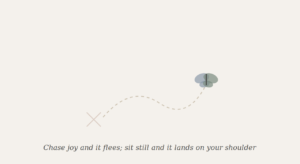
Watts often described what he called the “backwards law” — the more directly you chase a feeling like happiness or pleasure, the more it slips away, like trying to grab smoke. This is not just poetic language; it maps onto what neuroscience now understands about the brain’s reward circuitry. When the brain anticipates a reward, dopamine spikes — but the spike is tied to anticipation, not to having. Chase the next hit of pleasure, and the brain simply resets its baseline, demanding more to feel the same. This is the biology behind the hedonic treadmill.
The alternative the Buddhist path offers is not to suppress desire, but to stop making happiness the target of constant pursuit and instead let it arise naturally out of full engagement with the present moment. A craftsperson absorbed in their work, a parent fully present with a child, a walker noticing the texture of bark on a tree — none of them are chasing happiness in that moment, yet happiness is often exactly what they find. Genuine contentment tends to be a side effect of presence, not a goal pursued head-on.