
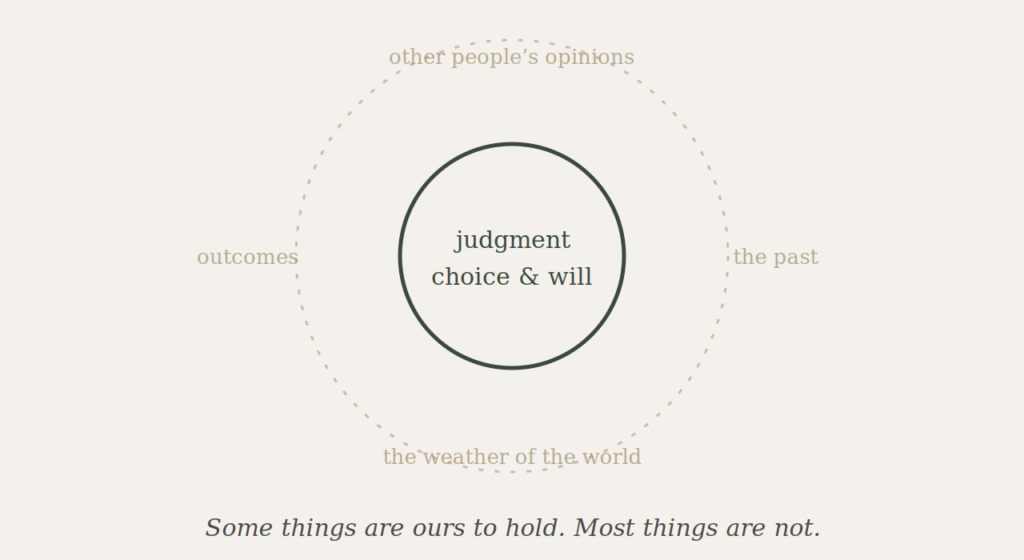
Some things are ours to hold. Most things are not.
Marcus Aurelius, who ruled the Roman Empire at the height of its power, returned again and again in his private notebook — what we now call Meditations — to a single dividing line: some things are within your control, and almost everything else is not. Your judgments, your choices, your effort, your character — these are yours. Other people’s opinions of you, the outcome of your work, the weather, the actions of others, even your own reputation after you’re gone — these are not, no matter how much energy you spend trying to manage them.
This isn’t resignation. It’s relief. So much of anxiety comes from gripping tightly to things that were never ours to control in the first place — what someone thinks of us, how a situation turns out, whether people behave the way we’d prefer. Marcus, who had more actual power than almost anyone alive in his time, still understood that none of it could buy him control over the one thing that mattered: his own mind’s response to events. He kept reminding himself of this not because he had already mastered it, but because it is the kind of truth that has to be relearned daily, especially under pressure.
When you stop spending your effort trying to manage what is outside your hands, something practical happens: you get that effort back, and you can spend it instead on the part of life you actually do control — how you choose to act, right now, in this situation.
Try this: Pick something you’re currently worried about. Write down which parts of it are genuinely within your control, and which parts are not. Let go of effort on the second list — even just for today.