
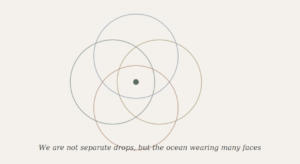

Alan Watts often pointed out that the Western mind has been trained to think of itself as a “self” trapped inside a body, peering out at a world that is fundamentally separate from it. Buddhism calls this illusion anatta, or non-self — the idea that the rigid, isolated “I” we cling to is more a story we tell than a fixed thing we are. When we believe we are a separate fortress that must defend itself against an indifferent world, the nervous system responds accordingly: muscles tighten, breath shortens, and the body lives in a constant low hum of threat.
But loosen that grip on a fixed, separate self, and something shifts. You begin to notice that your breath is borrowed from the air around you, that your thoughts arise from a culture and a history far larger than “you,” and that you are less a noun and more a verb — a process unfolding inside a much bigger process. This is not a loss of identity; it is a relief from the exhausting job of constantly protecting one. Research on chronic stress shows that the body keeps producing cortisol when we perceive ongoing threat to the self. Loosening self-identity, even slightly, can quiet that response and create more room for ease in both mind and body.