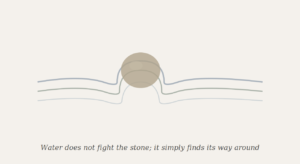
Watts spent much of his later work exploring Taoist philosophy, particularly the idea of wu wei, often translated as “effortless action” or “non-forcing.” His book The Watercourse Way uses water as the central metaphor: water does not struggle against obstacles, yet over enough time it can carve canyons through solid rock. Its power comes not from force, but from yielding intelligently to the shape of what it meets.
This principle shows up physically in the body more than we often realize. Resistance to life’s natural rhythms tends to manifest as clenched jaws, raised shoulders, shallow chest breathing, and tight fists — the body bracing against something it cannot actually stop. Buddhist practice encourages a similar quality of flow: meeting difficulty without unnecessary resistance, responding rather than reacting, bending without breaking. When the body is allowed to move with circumstance instead of constantly fighting it, the parasympathetic nervous system — responsible for rest, digestion, and repair — has more room to do its work.